
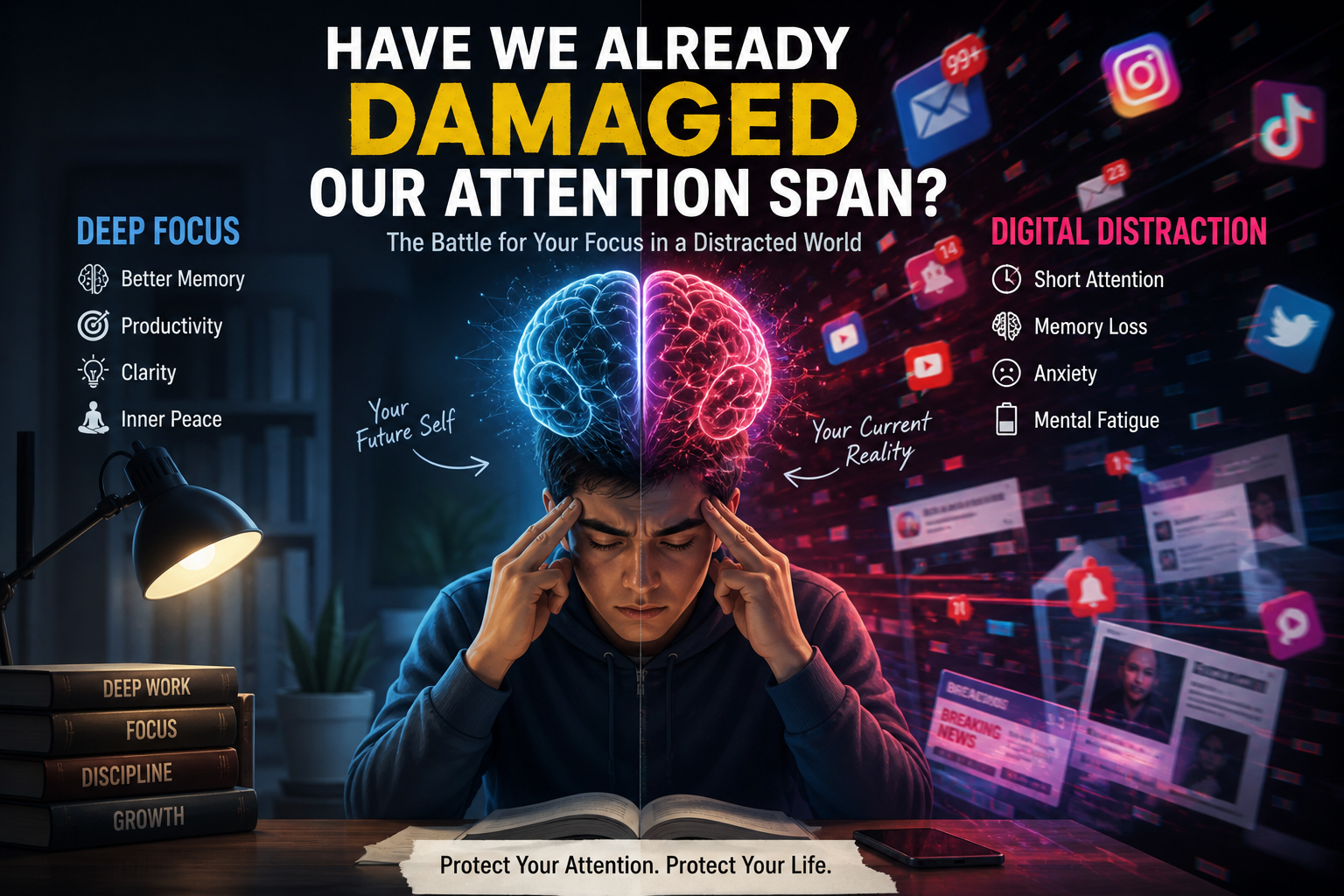
You try to focus—but within minutes, your mind drifts or your hand reaches for your phone.
This isn’t just a distraction.
It may be a change in how your brain processes attention.
What’s Happening to Your Brain?
Frequent digital stimulation trains the brain to prefer:
Quick rewards
Constant novelty
Short bursts of attention
Over time deep focus → feels effortful and shallow engagement → feels natural
Why Attention Is Declining
Dopamine-driven scrolling rewards quick switching. Lack of boredom reduces focus endurance. Multitasking weakens sustained attention. The brain adapts to speed, not depth
How to Assess Your Attention Span (Self-Test)
Ask yourself honestly:
1. Reading Test
Can you read for 10–15 minutes continuously without checking your phone?
2. Single-Task Test
Can you complete one task without switching tabs or apps?
3. Silence Test
Can you sit quietly for 5 minutes without stimulation?
4. Conversation Test
Do you stay fully present in a conversation without drifting?
5. Impulse Check
How often do you check your phone without a clear reason?
Signs Your Attention Span Is Reduced
– You feel restless during slow tasks
– You prefer short content over deep reading
– You get mentally tired quickly
– You avoid tasks requiring sustained focus
Can It Be Reversed?
Yes—because the brain is plastic.
Simple ways to improve attention:
Practice device-free time daily (10–20 min)
Read without interruption
Take walks without your phone
Allow boredom (don’t fill every gap)
These rebuild focus endurance

Conclusion
Your attention is not lost.
It is trained—and it can be retrained.
The real question is:
Are you training your brain for depth—or distraction?
Call to Action
If this feels familiar, share it with someone who says:
“I just can’t focus anymore.”
Please read and share!!!!
Happy Sunday!!!
Leave a Reply